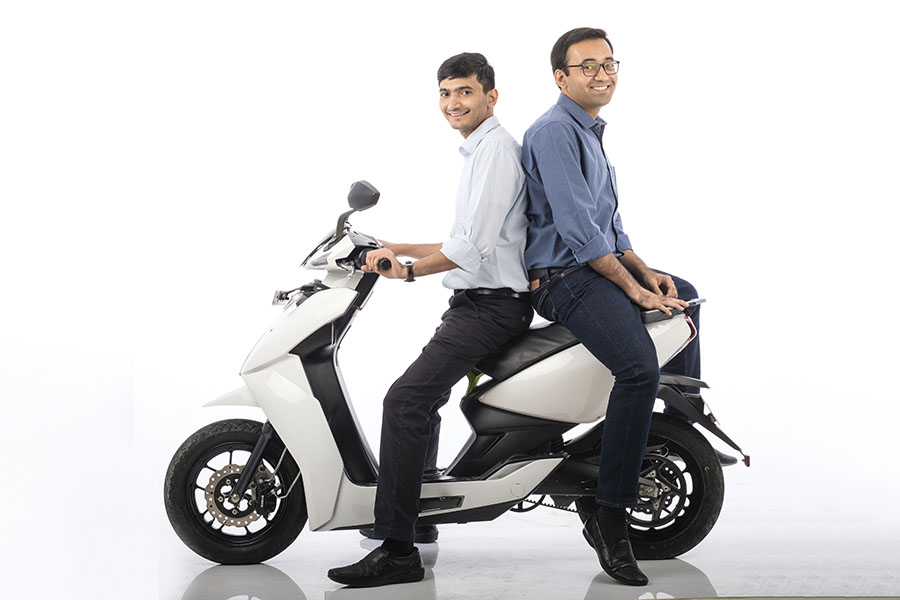
In 2013, two IIT Madras alumni, Tarun Mehta and Swapnil Jain, embarked on a journey that would redefine India’s electric vehicle landscape. Returning to their alma mater’s incubator, they focused on developing a lithium-ion battery pack—a significant advancement over the traditional batteries used in electric vehicles at the time. Initially, their vision was to create swappable batteries for scooters, aiming to supply these to existing manufacturers. However, they soon realized a glaring gap in the market: there wasn’t a scooter that met their aspirations.
Identifying the Gap: The Birth of an Idea
The duo observed that electric scooter owners frequently lamented the lack of power and poor battery life. Identifying this pain point, they set out to build an aspirational electric scooter centered around a robust lithium-ion battery. The path from concept to execution was daunting, especially in a capital-intensive industry like automobile manufacturing. As young, first-time entrepreneurs without prior experience in scooter production and limited initial capital, the odds were stacked against them.
Breaking Barriers: Overcoming Funding Challenges
In a landscape where many startups gravitated towards internet-based ventures, Ather Energy took the unconventional route of manufacturing an electric scooter from scratch. The challenges were manifold: an unproven electric scooter market, years of development without revenue, and the looming uncertainty of profitability. Their credentials as first-time entrepreneurs with limited experience further complicated their quest for funding.
Despite these hurdles, Ather found its angels in Flipkart founders Sachin Bansal and Binny Bansal, who invested $1 million in seed capital in December 2014. This endorsement not only provided financial support but also bolstered Ather’s credibility. Encouraged by this vote of confidence, Tiger Global invested $12 million in May 2015, facilitating further development and testing.
Strategic Backing: The Hero MotoCorp Partnership
By late 2016, recognizing the need for seasoned expertise, Ather secured a $19 million investment from Hero MotoCorp. This partnership transformed Ather, providing insights into manufacturing processes and opening doors to a network of suppliers and component manufacturers. With Hero’s backing, Ather was poised to transition from a scrappy startup to a formidable contender in the two-wheeler market.
Tapping into a Massive Market
India’s two-wheeler market is vast, with over 20 million units sold annually. However, the segment was predominantly dominated by petrol or diesel vehicles. Electric scooters were largely absent or unaffordable to the average consumer. Ather aimed to change this narrative by introducing electric scooters that combined performance, reliability, and affordability.
Riding the EV Wave: Why Timing Was Perfect
The global shift towards cleaner energy and the rising cost of fuel created a conducive environment for electric vehicles. Inspired by Tesla’s success in making electric cars aspirational, Ather sought to replicate this in the two-wheeler segment. Their goal was to offer a product that wasn’t just an alternative to petrol scooters but a superior choice in terms of performance and user experience.
Launching the Future: Ather’s First Scooters
Ather unveiled its first scooter, the S340, in February 2016. After rigorous testing and development, the Ather 450 was launched in 2018, priced at ₹1.24 lakh. The scooter boasted features like rapid acceleration, a balanced chassis, and a connected dashboard with navigation, offering a seamless riding experience. To support its adoption, Ather also initiated the setup of a charging infrastructure, recognizing that convenience in charging was pivotal to user acceptance.
Scaling Up: Ather’s Business Expansion
Ather set ambitious targets, aiming to produce 20,000 units in its first year. Achieving economies of scale was crucial, with projections indicating unit-level breakeven at approximately 75,000 units and EBITDA-level breakeven at 200,000 units. The emphasis was clear: scaling production and sales was essential to financial sustainability.
The EV Boom: Ather’s Growth Trajectory
The Indian government’s vision to have 30% of vehicles go electric by 2030, up from 1% in 2024, underscores the immense growth potential in the electric two-wheeler segment. Even without market expansion, this translates to a 30-fold increase, representing a 40% annual growth rate over a decade. While challenges like charging infrastructure and consumer education remain, companies like Ather are strategically positioned to lead this transformation.
Recent Milestones: Dominating the Market
In April 2024, Ather launched the Rizta, a family-oriented electric scooter. By July 2024, the Rizta dominated Ather’s sales, accounting for 61% of the 11,088 units sold that month. (rushlane.com)
October 2024 marked Ather’s highest-ever monthly sales, with over 18,000 units sold, 60-70% of which were Rizta models. (ndtv.com)
In March 2025, Ather filed for an IPO, aiming to raise approximately $400 million at a valuation of $1.2 billion. (bloomberg.com)
The Road Ahead: Powering India’s EV Future
Ather Energy’s journey—from a humble startup in an academic incubator to a leading player in India’s electric vehicle market—epitomizes innovation, resilience, and strategic vision. As the company accelerates into the future, it continues to electrify India’s roads, one scooter at a time.


 dissectvc.com